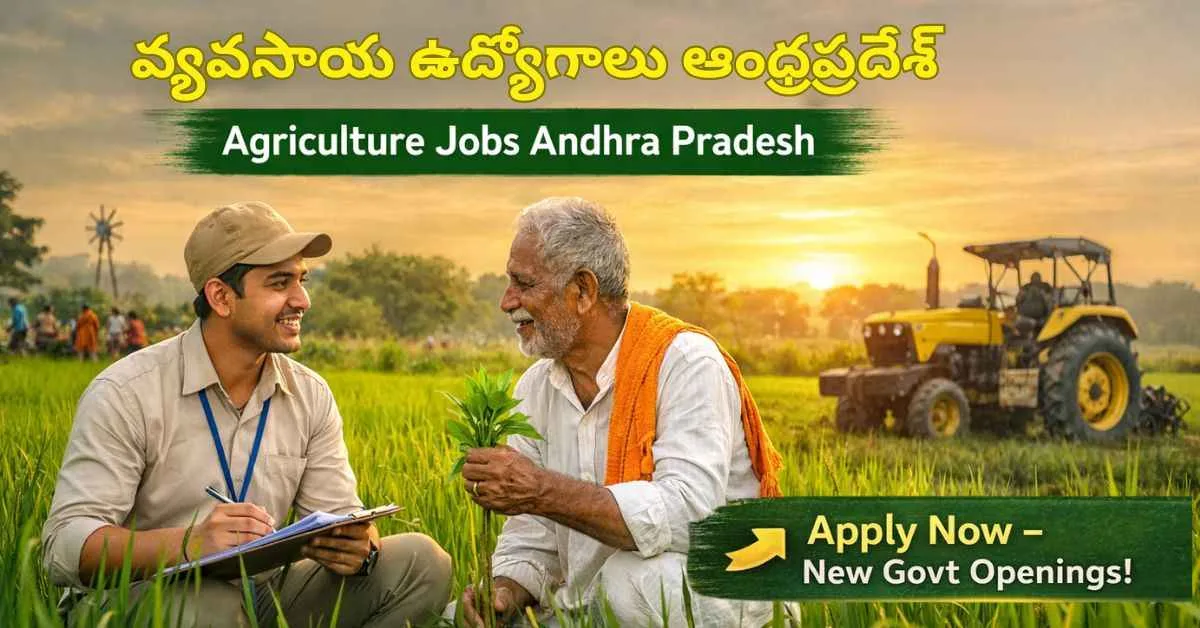
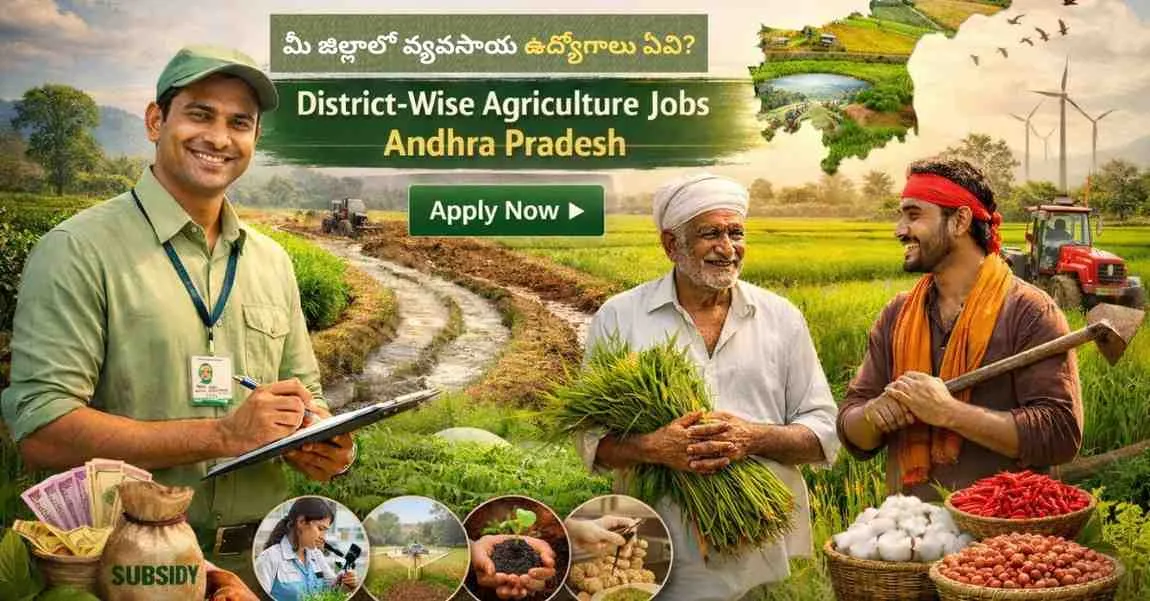
Andhra Pradesh lo BSc Agriculture complete chesina prati student ki oka common doubt untundi — “Naa district lo agriculture department lo em jobs untaayi? Naa jilla ki sambandinchina posts ela telusukovali? APPSC notification lo district-wise vacancies ela allocate avthaayi?” Ivi chala valid questions, and most students ki proper answers teliyavu. That’s exactly why I’m writing this detailed guide on District-Wise Agriculture Jobs in Andhra Pradesh.
See, AP is not one uniform agricultural state. The coastal delta is completely different from the Rayalaseema drylands. Guntur’s chilli and tobacco economy is different from Anantapur’s groundnut belt. Krishna and Godavari paddy fields are different from Chittoor’s mango orchards. Naturally, the government’s staffing needs, the nature of work, and the specific schemes implemented vary significantly from district to district.
వ్యవసాయ ఉద్యోగాల తాజా నోటిఫికేషన్స్ మిస్ అవ్వకుండా ఉండాలంటే ఇప్పుడే మా అధికారిక WhatsApp ఛానల్లో జాయిన్ అవ్వండి!
WhatsApp Channel
Also Read

AO AEO Study Plan – 30 రోజుల్లో ఎక్కువ మార్కులు సాధించే పూర్తి గైడ్
Ee article chadivina taruvatha, you’ll know exactly which posts exist in each district, what crops dominate, what kind of work you’ll do, and how to prepare for APPSC exams with district-level awareness. Whether you’re targeting the lush paddy mandals of Konaseema or the rugged cotton fields of Kurnool, this guide covers everything.
Ippudu chala mandi students general ga “agriculture jobs kavali” ani prepare avtharu, but district-wise specifics telusukoru. But APPSC interview stage lo, and even in the mains exam, questions about local crop patterns, district schemes, and regional agricultural challenges common ga vasthaayi. So knowing your district deeply is both a career advantage and an exam necessity.
What Are District-Wise Agriculture Jobs?
District-Wise Agriculture Jobs ante, Andhra Pradesh lo prati jilla lo agriculture department, horticulture department, and related agencies lo unde specific government posts. These posts are filled through APPSC or departmental recruitment, and the vacancies are announced district-wise or zone-wise depending on the cadre rules.
These jobs are not centralized state-level postings where you could be sent anywhere. Instead, your posting is generally within a district or a zone (group of districts). APPSC allocations often follow the zonal system — zones 1 through 4 — with candidates allotted to their home zone whenever possible, though this is subject to vacancy availability and roster rules.
The types of posts you’ll find at the district level include Agriculture Officer (AO), Agriculture Extension Officer (AEO), Horticulture Officer (HO), Village Agriculture Assistant (VAA), Assistant Director of Agriculture (ADA), and various scheme-specific roles. Each district has a sanctioned strength of these posts based on its cultivated area, number of farmers, and cropping intensity.
District-Wise Crop Profiles and Job Nature
Let me walk through each major district or region and explain what kind of agricultural work dominates, because your job experience will be shaped by these local realities.
Guntur District
Guntur is the chilli and tobacco capital. This district has some of the most commercially intense agriculture in the state. As an officer here, you’ll deal with export-quality chilli production, tobacco board regulations, and high-value crop marketing. Pest management in chilli is a major responsibility — thrips, mites, and viral diseases are constant threats. The work is fast-paced, and farmer expectations are high because the crop value is high. Guntur also has a significant cotton area in its eastern mandals.
Krishna District
Krishna is the heart of the delta, with extensive paddy cultivation supported by the Krishna river and its canal network. Water management, fertilizer optimization, and mechanization promotion are key responsibilities. The district also has substantial sugarcane and pulses cultivation. Work here involves coordinating with irrigation department regularly, as canal water scheduling directly impacts cropping decisions.
East Godavari District
Often called the rice bowl of Andhra, East Godavari has the highest paddy acreage in the state. The Konaseema delta is lush and productive. Along with paddy, coconut plantations and aquaculture are major economic activities. As an officer here, paddy-related schemes — seed subsidies, fertilizer distribution, procurement support — will dominate your work. The district also has significant horticulture in its upland mandals with cashew and mango.
West Godavari District
Similar to East Godavari in its deltaic character, West Godavari is known for paddy, sugarcane, and increasingly, aquaculture and palm oil. The district has a strong cooperative sector in sugarcane. Coordinating with sugar factories, managing harvest schedules, and implementing cane development schemes are unique aspects of work here that you won’t find in many other districts.
Kurnool District
Kurnool is cotton country. This is one of the largest cotton-producing districts in the state, heavily dependent on rain-fed farming. Pink bollworm management, Bt cotton seed regulation, and drought contingency plans are core responsibilities. The district also has significant groundnut, sunflower, and Bengal gram cultivation. Work here is challenging because rainfall is erratic, and farmer distress periods require sensitive handling and swift scheme implementation.
Anantapur District
Anantapur is synonymous with groundnut. It’s one of the driest districts, with chronic water scarcity. Groundnut, red gram, and horticulture crops like sweet lime dominate. The work here revolves around drought-proofing — promoting drought-resistant varieties, micro-irrigation, soil moisture conservation, and crop insurance. Officers posted here develop deep expertise in dryland farming that is valued throughout the department.
Chittoor District
Chittoor is the horticulture hub — mango, tomato, and various vegetables dominate. The district supplies to Chennai, Bangalore, and beyond. Cold storage, grading, and market linkages are part of the agricultural ecosystem here. As an officer, you’ll work closely with horticulture schemes, export promotion programs, and post-harvest infrastructure development. The district’s proximity to major cities creates unique marketing opportunities and challenges.
Nellore, Prakasam, Kadapa, Srikakulam, Vizianagaram, Visakhapatnam
Each of these districts has its own character. Nellore combines paddy with aquaculture. Prakasam has flue-cured tobacco and pulses. Kadapa has groundnut, sunflower, and horticulture in its eastern parts. The north coastal districts — Srikakulam, Vizianagaram, and Visakhapatnam — have paddy in the plains, cashew and mango in the uplands, and tribal agriculture in the agency areas requiring special approaches and tribal welfare scheme knowledge.
Eligibility Criteria for District-Wise Posts
To apply for District-Wise Agriculture Jobs, you must meet standard eligibility conditions. Educational qualification requires BSc Agriculture or BSc Horticulture from a recognized university. For some VAA-level posts, Diploma in Agriculture may be considered, but a degree is always preferred and gives you access to more posts.
Age limits as per APPSC: 18 to 42 years for general category, with relaxation for SC, ST, BC, and other reserved categories. Domicile requirement: you must be a local candidate of Andhra Pradesh with a valid residence certificate. If applying for zonal posts, zone-specific local status may be required.
Beyond formal criteria, being fluent in Telugu is essential. All farmer interactions happen in Telugu. Being able to explain technical concepts in simple, local language — not textbook English — is a skill that makes you effective and respected in the field. Computer literacy for data entry on government portals is increasingly important too.
Salary and Pay Structure
The salary for District-Wise Agriculture Jobs follows standard government pay scales with regular increments. Entry-level AEO posts typically start at Rs 40,000 to Rs 55,000 per month (including allowances). Agriculture Officers earn Rs 45,000 to Rs 60,000. Senior posts like ADA can reach Rs 70,000 to Rs 90,000 plus.
In addition to basic pay, government employees receive DA (revised twice yearly to offset inflation), HRA (based on posting city class), and Travel Allowance for field visits — which is substantial since these are field-intensive jobs. Medical benefits, pension, and other allowances further enhance the compensation package.
Salary growth is steady and predictable. After 5 years, an AEO can expect Rs 55,000 to Rs 65,000. A full career of 30 years can take you to senior levels drawing over Rs 1 lakh per month. While private sector jobs may offer faster initial growth, government salaries offer unmatched long-term security and post-retirement benefits.
APPSC Exam Pattern and Preparation
APPSC conducts exams for most district-level agriculture posts. The selection process typically has a written examination covering core agriculture subjects plus General Studies and Mental Ability, followed by document verification. Some posts may include an interview.
Core subjects tested include agronomy, soil science, entomology, plant pathology, horticulture, agricultural economics, and extension education. The General Studies paper covers current affairs, AP state economy, geography, history, and reasoning ability. Both papers are available in Telugu and English.
For district-wise preparation, pay special attention to the crops, soil types, irrigation sources, and major schemes active in major districts of AP. You should know that Guntur leads in chilli, Anantapur in groundnut, Chittoor in mango, the Godavaris in paddy, and Kurnool in cotton. Such district-level knowledge impresses in interviews and helps in objective questions too.
Study previous question papers thoroughly. Practice mock tests under timed conditions. Follow AP agricultural news regularly. And consider forming study groups with peers from different districts to share local knowledge and insights.
Government vs Private Sector Agriculture Jobs
In District-Wise Agriculture Jobs under the government, you get job security that is virtually absolute, fixed working hours, and pension benefits after retirement. Your role is service-oriented — helping farmers directly through government programs. Private sector jobs in agri-input companies, food processing, or agri-tech offer faster salary growth, corporate exposure, and sometimes more exciting technological work.
Government postings are in rural and semi-urban areas — mandal towns, district headquarters. Private jobs are more likely to be in cities or larger towns. Government work pressure is moderate with predictable seasonal peaks. Private sector has year-round targets, quarterly reviews, and performance-based stress. Government promotions are time-bound. Private promotions are performance-driven.
Both have their merit. If you value stability, service, and long-term security, government district-wise posts are excellent. If you want rapid growth, urban lifestyle, and corporate experience, private sector may appeal more. The good news is that experience in one sector often makes you more valuable in the other later.
Work Responsibilities – Field and Office Balance
A common misconception is that agriculture officers just sit in offices all day. The reality is very different. Your time is split roughly 60% field and 40% office, though this varies by season and post. During sowing and harvest seasons, field work can dominate 80% of your time.
Field responsibilities include visiting farms to inspect crop conditions, collecting soil and plant samples for lab testing, verifying crop loss for insurance claims, checking input quality at dealer shops, conducting farmer training demonstrations, and supervising scheme implementation on the ground. Office work involves writing field visit reports, updating digital records on government portals, processing farmer applications for subsidies, preparing monthly progress reports, and attending coordination meetings.
Village-level officers like VAA spend the most time in the field — almost daily farmer contact. Mandal-level AEOs balance field visits with reporting. District-level officers focus more on planning, supervision, and administration, but still do field inspections regularly. The higher you go, the more strategic and less directly field-intensive your role becomes.
Promotion and Career Growth Path
The career ladder in District-Wise Agriculture Jobs is well-structured. You can enter as an AEO (Agriculture Extension Officer) through APPSC. With 4 to 6 years of service and good performance, promotion to Agriculture Officer (AO) becomes possible. After 8 to 10 years, you can reach Assistant Director (ADA) level. Further promotions lead to Deputy Director, Joint Director, and eventually Director of Agriculture.
Promotions are based on a seniority-cum-merit system. Annual performance reports, departmental exam clearance, and experience in different roles all contribute. There are also opportunities for lateral movement — deputation to agricultural universities, special project assignments, and training positions within the department.
The key to fast career growth is strong field performance, clean record-keeping, good farmer relations, and willingness to take on challenging postings like remote or difficult mandals. Officers who perform well in hardship postings often get accelerated consideration for better roles later.
Real-Life Challenges on the Job
Like any career, district-level agriculture jobs have challenges. The most common one is managing farmer expectations. Farmers often expect immediate action on their problems, but government processes have defined steps and timelines. Bridging this gap with clear, empathetic communication is a skill you learn.
Working in remote villages with limited infrastructure can be physically demanding. Traveling on rough roads in summer heat or during rains is part of the job. Maintaining energy and health is important. Bureaucratic procedures can be slow and sometimes frustrating. Building good relationships across departments helps. Political pressure can occasionally test your integrity — staying honest, polite, and firm is essential.
Despite these challenges, the job satisfaction is high. When you help a farmer get their rightful insurance claim, when your soil recommendation saves them thousands in fertilizer costs, or when a scheme you implemented reaches families who genuinely needed it — that sense of purpose is powerful and lasting.
Frequently Asked Questions (FAQ)
1. Can I choose which district I get posted in?
Postings are based on vacancy availability and roster rules within zones. While you can express preferences and sometimes request transfers after minimum service, initial postings are at the department’s discretion based on administrative needs.
2. Which district has the most agriculture job vacancies?
Large districts with high cropping intensity like East Godavari, Guntur, and Krishna typically have more sanctioned posts. However, vacancy levels fluctuate based on retirements, promotions, and new scheme implementations. Check APPSC notifications for current vacancy details.
3. Is BSc Horticulture valid for all agriculture department posts?
BSc Horticulture is valid for Horticulture Officer posts and some general agriculture posts. However, for core Agriculture Officer roles, BSc Agriculture is specifically required in many notifications. Check each notification carefully for the exact degree requirements.
4. How do I stay updated on district-wise notifications?
Regularly check the APPSC website (psc.ap.gov.in), the AP Department of Agriculture website, and employment news. Also, many Telegram groups and websites track AP government job notifications specifically for agriculture graduates.
5. What is the typical work day like in a mandal-level post?
A typical day starts at the mandal office around 9 to 10 AM with file review and planning. By mid-morning, you visit villages for field inspections, farmer meetings, or scheme verification. Afternoon involves report writing, data entry, and sometimes coordination meetings. During peak seasons, field work can extend throughout the day.
To sum it up, District-Wise Agriculture Jobs in Andhra Pradesh offer a career that combines professional stability, social respect, and genuine public service. Whether you end up in the paddy fields of Konaseema or the cotton belt of Kurnool, you’ll be making a real difference in farmers’ lives while building a secure career. Plan your preparation district-specifically, stay updated on notifications, and when the opportunity comes, apply with confidence.
మూలాలు
- APPSC అధికారిక వెబ్సైట్ – ఆంధ్రప్రదేశ్ పబ్లిక్ సర్వీస్ కమిషన్
- ఆంధ్రప్రదేశ్ ప్రభుత్వం అధికారిక వెబ్సైట్
- ఆంధ్రప్రదేశ్ వ్యవసాయ శాఖ అధికారిక పోర్టల్
సంబంధిత కథనాలు
- Agriculture Jobs in Telangana – Complete Career Guide(తెలంగాణ వ్యవసాయ ఉద్యోగాల పూర్తి మార్గదర్శిని)
- Agriculture Entrepreneurship & Consultancy Careers (Advanced) – వ్యవసాయ వ్యాపారం & కన్సల్టెన్సీ కెరీర్ గైడ్ (Andhra Pradesh)
- AP Agriculture Exams Preparation: APPSC వ్యవసాయ పరీక్షలకు ఎలా సిద్ధం కావాలి? సిలబస్ & స్టడీ ప్లాన్
వ్యవసాయ ఉద్యోగాల తాజా నోటిఫికేషన్స్ మిస్ అవ్వకుండా ఉండాలంటే ఇప్పుడే మా అధికారిక WhatsApp & Telegram ఛానళ్లలో జాయిన్ అవ్వండి!
 WhatsApp Channel
 Telegram Channel

నేను A. Ushasree. gardenhacks.in లో వ్యవసాయ ఉద్యోగాలు, రైతు పథకాలు, హోమ్ గార్డెనింగ్ వంటి విభాగాలపై సరళమైన తెలుగులో ఉపయోగకరమైన సమాచారాన్ని పంచుకుంటాను. రైతులు మరియు సాధారణ కుటుంబాలకు ఉపయోగపడే సమాచారం అందించడం నా లక్ష్యం.