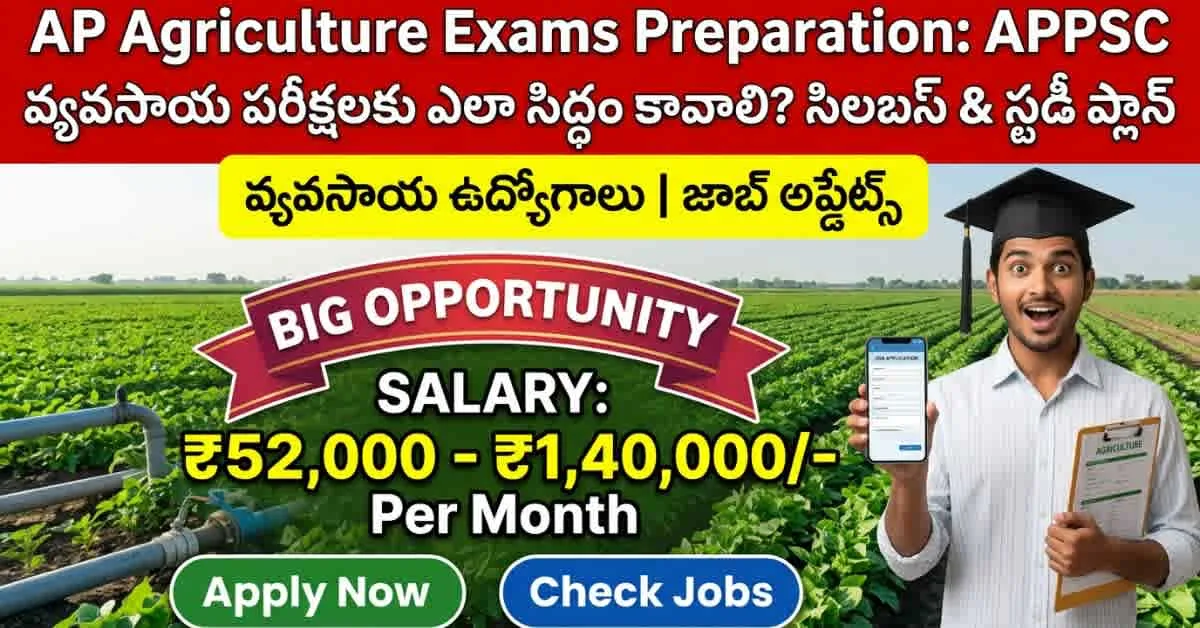
APPSC agriculture exams kosam prepare avtunnara? Syllabus peddaga undi, ekkada nunchi start cheyalo teliyatleda? Ee confusion lo chala mandi aspirants stuck avtunnaru — and it’s completely normal. AP Agriculture Exams Preparation isn’t about studying harder; it’s about studying smarter. With the right strategy, structured plan, and consistent execution, cracking these exams is absolutely achievable. Let me give you the complete roadmap — from syllabus clarity to final revision — that actual successful candidates have used.
వ్యవసాయ ఉద్యోగాల తాజా నోటిఫికేషన్స్ మిస్ అవ్వకుండా ఉండాలంటే ఇప్పుడే మా అధికారిక WhatsApp ఛానల్లో జాయిన్ అవ్వండి!
WhatsApp Channel
Problem → Decision → Result: The Framework
Common Problems Aspirants Face
- Syllabus clarity లేదు — what to study, what to skip తెలియదు
- Important topics vs less important topics differentiate చేయలేకపోతున్నారు
- Study ఎలా start చేయాలో direction లేదు
- Multiple sources lo confuse avtunnaru
- Consistency maintain చేయలేకపోతున్నారు
Decision Points
- Serious ga AP Agriculture Exams Preparation cheyadam ready na?
- Proper study plan follow avvagalana?
- Discipline and consistency maintain chestana?
Results Worth Working For
- Government job with stability and pension
- Respected role as Agriculture Officer serving farmers
- Steady income with regular increments and benefits
- Career with clear promotion ladder
Quick Decision Table: Is This Path for You?
| ప్రమాణం | సూచన |
|---|---|
| AP Aspirant with Agriculture Background | Right choice — your degree is directly applicable |
| Agriculture Degree Required | Mandatory — B.Sc Agri / Horticulture / Seed Tech |
| Government Job Interest | Excellent fit — stable, respected career |
| Quick Results Expected | Tough — this requires 6+ months of dedicated preparation |
| Discipline & Consistency | Non-negotiable — daily study is the foundation |
Who This Is For / Who It’s Not For
Perfect For:
- Agriculture graduates (B.Sc Agri, Horticulture, Seed Technology)
- Aspirants seeking stable government employment with benefits
- Those who can commit to consistent, disciplined study over months
- People passionate about serving farmers and rural communities
Not Ideal For:
- Those needing immediate employment (preparation takes 6+ months)
- Candidates without any agriculture background
- Those preferring private sector’s faster growth and urban lifestyle
Exam Overview: What You’re Preparing For
AP agriculture exams are state-level competitive examinations conducted by APPSC. They test both subject knowledge and general aptitude. The exams are objective-type (multiple choice), and your rank determines your posting — from village level (VAA) to mandal level (AEO) to district level (AO, ADA).
Also Read
Agriculture Jobs in Telangana – Complete Career Guide(తెలంగాణ వ్యవసాయ ఉద్యోగాల పూర్తి మార్గదర్శిని)
Eligibility at a Glance
| అంశం | వివరాలు |
|---|---|
| విద్యార్హత | B.Sc Agriculture / Horticulture / Diploma |
| వయస్సు | As per government norms (typically 18-42) |
| స్థానికత | AP Local Certificate mandatory |
| పత్రాలు | Degree certificate, caste certificate, local certificate |
Salary Structure — Your Future Earnings
| దశ | జీతం |
|---|---|
| Starting Level | ₹35,000 – ₹45,000 |
| After 5 Years | ₹50,000+ |
| Senior Level | ₹70,000+ |
Government employees additionally receive HRA, DA, pension benefits, and job security — making the total compensation package significantly attractive over a full career.
Exam Pattern and Syllabus
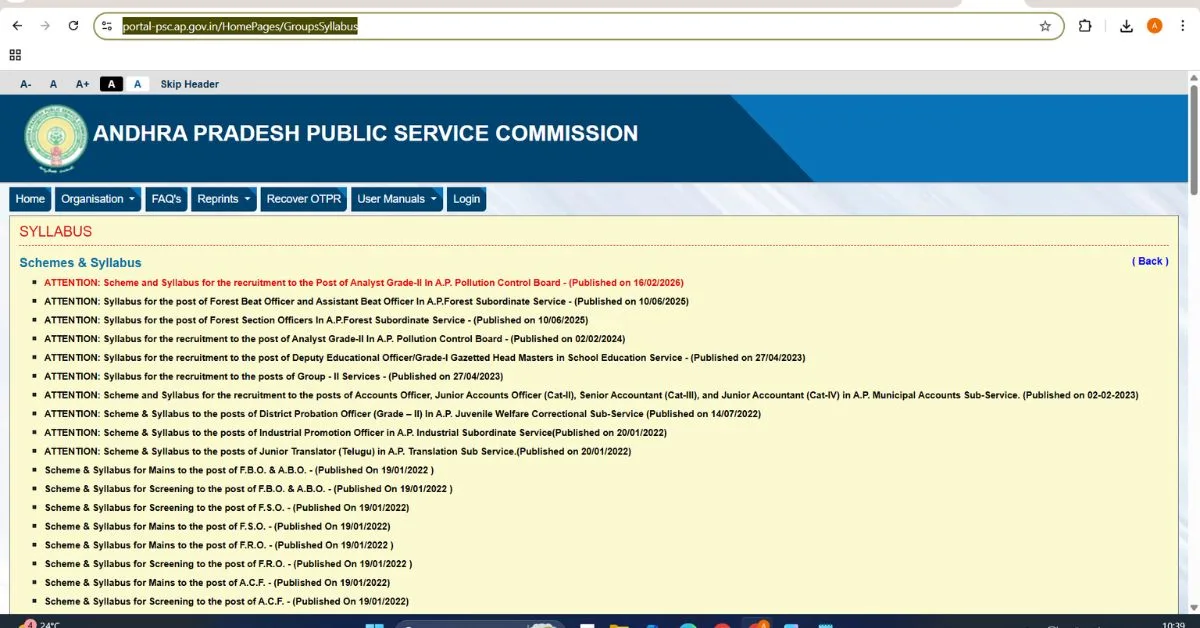
Exam Structure:
- Paper 1: General Studies & Mental Ability (150 marks) — tests your awareness of current affairs, reasoning, and basic aptitude
- Paper 2: Core Agriculture Subjects (300 marks) — the heavyweight paper that determines your rank
- Interview: 50 marks — tests communication, practical knowledge, and suitability
Core Subjects to Master:
- Agronomy: Crop production techniques, soil management, water management, cropping systems, sustainable agriculture
- Soil Science: Soil types, properties, fertility, testing methods, soil conservation
- Plant Protection: Pest identification, disease management, integrated pest management, safe pesticide use
- Agricultural Economics: Farm management, marketing, government schemes, rural development
- Seed Technology: Seed production, quality testing, storage, certification
👉 Download Complete APPSC Agriculture Syllabus Here

The Study Plan That Works
Daily Schedule (4-6 Hours)
- Morning (2 hours): Core agriculture subjects — fresh mind, complex topics
- Midday (1 hour): General Studies — current affairs, AP-specific news
- Afternoon (1 hour): Practice questions / problem-solving
- Evening (1 hour): Revision — what you studied today + previous topics
Weekly Plan
- 6 days of study, 1 day for rest and light review
- Every Sunday: one full mock test under timed conditions
- Analyze mock test results — identify weak areas, adjust next week’s focus
- Review previous year question papers for pattern familiarity
Preparation Timeline
| సమయం | లక్ష్యం |
|---|---|
| Months 1-2 | Basics complete — all subjects covered at fundamental level |
| Months 3-4 | Full syllabus completion — deep dive into each topic |
| Months 5-6 | Mock tests + intensive revision + weak area strengthening |
Subject-wise Preparation Strategy
Every subject in AP Agriculture Exams Preparation demands a different approach:
Agronomy
Focus on concepts and practical applications. Understand crop seasons, irrigation methods, and fertilizer calculations. Make flowcharts and diagrams — they help retention and are useful for quick revision.
Soil Science
Master definitions, classifications, and soil testing methods. Diagrams are your best friend here. Practice sketching soil profiles and remembering key values (pH ranges, nutrient levels) for quick recall during exams.
Plant Protection
Create disease-pest-control method tables. Memorize scientific names of major pests and diseases affecting common AP crops. Focus on integrated pest management (IPM) — this is a frequently tested topic.
General Studies & Current Affairs
Follow daily AP-specific news. Focus on agriculture-related government schemes, budget allocations, and rural development programs. Make short notes — don’t try to memorize everything.
Revision Strategy — The Make-or-Break Factor
చదివింది gurtu undalante revision is everything. Most aspirants study but don’t revise — and that’s the single biggest mistake. Here’s your revision protocol:
- Daily: 1 hour dedicated to revising what you studied that day + quick review of previous days’ key points
- Weekly: One session covering the entire week’s study — 3-4 hours on your rest day
- Key Formulas & Points: Maintain a separate notebook of must-remember facts, formulas, and diagrams. Review these daily.
- Active Recall: Don’t just re-read notes. Close the book and try to recall. This is scientifically proven to be far more effective than passive re-reading.
Time Management During Preparation
Structure your day for peak productivity:
- Morning (fresh mind): New, complex topics — agronomy concepts, soil science details
- Afternoon: Practice questions, problem-solving, current affairs reading
- Evening: Revision — consolidate what you learned today
- Night: Light review, plan tomorrow’s schedule
Consistency beats intensity. Studying 4 hours every single day for 6 months produces far better results than 10-hour cram sessions followed by burnout.
The Power of Previous Year Papers
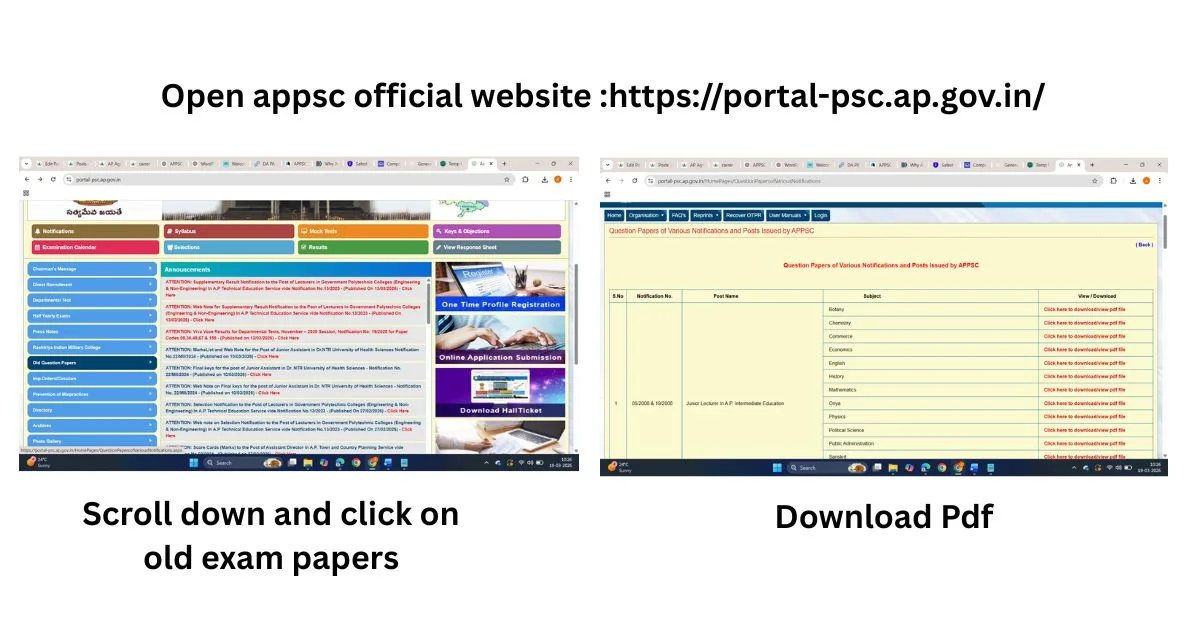
Previous year question papers are gold for three reasons:
- Pattern Recognition: You understand the exam’s structure, question types, and mark distribution — no surprises on exam day.
- Repeated Questions: Many questions (or their variations) repeat across years. Spotting these patterns gives you easy marks.
- Confidence Building: Solving real past papers builds exam-day confidence. You know what to expect.
Aim to solve at least 10 years of previous papers during your preparation. Analyze every wrong answer — understanding why you got it wrong is more valuable than getting it right.
👉 Download APPSC Previous Year Question Papers
Smart Preparation Tips from Toppers
- Make Short Notes: Condense each topic into 1-2 pages. These become your rapid revision material in the final weeks.
- Practice Daily: Even 30 minutes of practice questions beats zero practice. Build the habit.
- Weekly Analysis: Every Sunday, review your week. What worked? What didn’t? Adjust the next week accordingly.
- Set Clear Goals: “Complete soil science chapter 3 by Wednesday” is better than “study soil science this week.” Specificity drives action.
- Mock Tests Under Exam Conditions: Same time limit, same environment — simulate the real exam. This builds mental stamina.
Common Mistakes to Avoid
- Too Many Sources: Pick 2-3 standard textbooks and stick to them. More sources = more confusion, not more knowledge.
- Study Without Planning: Waking up and deciding “I’ll study something today” is a recipe for inefficiency. Plan your week in advance.
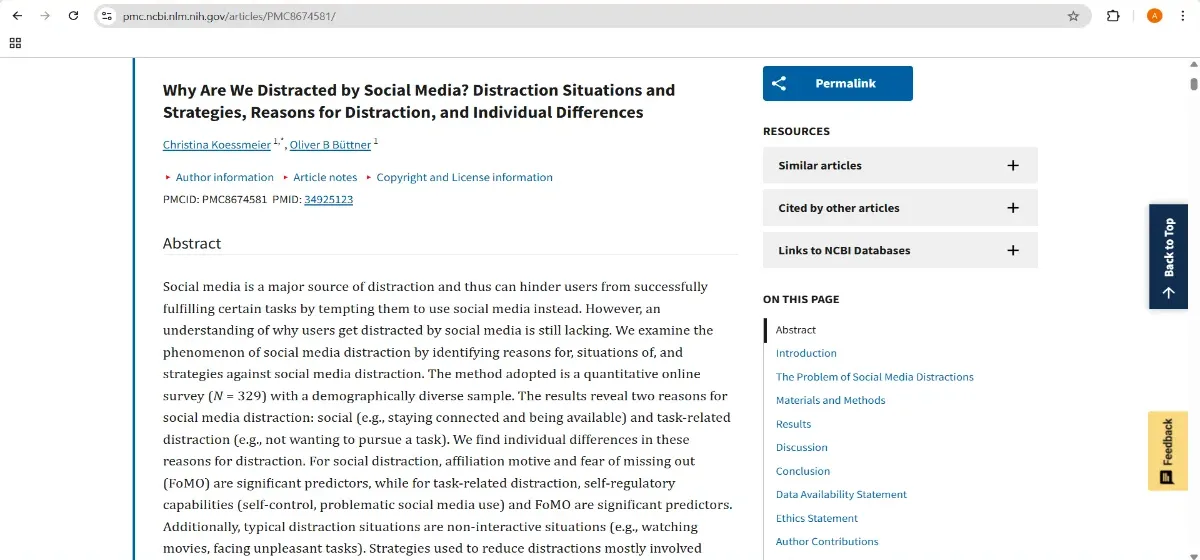
- Social Media Distraction: The single biggest productivity killer. Use app timers. Keep your phone in another room during study hours.
- Skipping Revision: You will forget 60% of what you studied within 48 hours if you don’t revise. Revision isn’t optional — it’s the core of your strategy.
- Excessive Focus on One Subject: Don’t spend two weeks perfecting agronomy while ignoring other subjects. Rotate subjects to maintain balanced coverage.
Final 30 Days Strategy
The last month is critical — use it wisely:
- No New Topics: Now is not the time to start unfamiliar chapters. Stick to what you know and strengthen it.
- Full Revision Cycles: Go through your short notes cover to cover. Aim for 2-3 complete revision cycles in the final 30 days.
- Mock Tests Every 2-3 Days: Simulate exam conditions. Analyze performance. Fine-tune time allocation per section.
- Time Management Practice: Know exactly how many minutes you’ll spend on each section. Have a strategy and practice it.
- Health Management: Sleep 7-8 hours. Eat well. Light exercise. A tired mind performs poorly — exam day is not the day to run on caffeine and 4 hours of sleep.
Motivation and Mindset
Preparation journey lo demotivation vastundi — it happens to everyone. Here’s how to stay strong:
- Focus on daily small progress, not the distant goal
- Don’t compare your journey with others — everyone’s pace is different
- Take breaks without guilt — burnout helps nobody
- Remember why you started: a stable career serving farmers and rural communities
- Visualize your name on the selection list — mental rehearsal is powerful
Application Process: Don’t Miss the Window
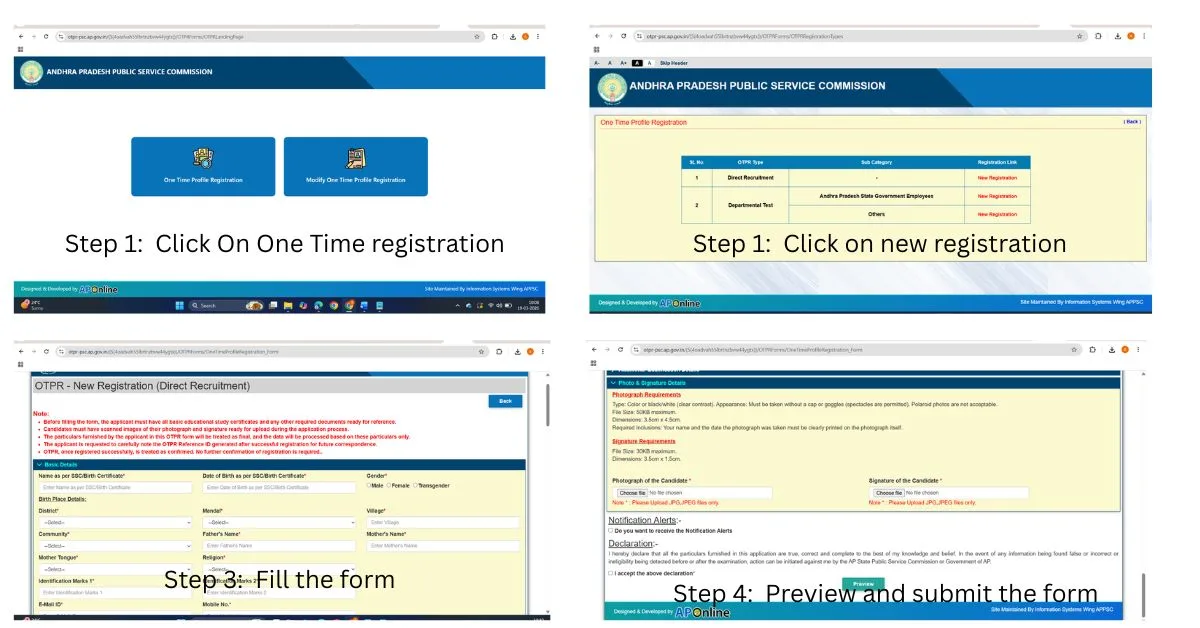
- Visit psc.ap.gov.in — the official APPSC portal
- Complete one-time registration with your basic details
- When the agriculture notification releases, login and apply
- Upload required documents (degree, certificates, photo, signature)
- Pay the application fee online
- Download and save your hall ticket when released
👉 Register on APPSC Portal Now
A Real Success Story
గుంటూరు జిల్లా కి చెందిన Ramesh — degree complete chesaka, APPSC agriculture exam ki prepare avvali ani decide ayyadu. Modatlo syllabus chusi overwhelm ayyadu. “Ee syllabus complete cheyadam possible na?” anipinchindi. But he made one smart decision: he stopped worrying and started planning. He broke the syllabus into weekly chunks. He studied 5 hours daily with discipline. He made short notes for every topic. He took a mock test every Sunday without fail. The first few mock scores were disappointing — but he analyzed every mistake, identified his weak areas (soil science and plant protection), and doubled down on them. Four months later, his mock scores had doubled. Six months in, he cleared the exam with a solid rank. Today, he’s an Agriculture Extension Officer serving farmers in his own district — stable income, government benefits, and genuine social respect. His journey proves: structured AP Agriculture Exams Preparation works. Consistency and smart strategy beat raw intelligence every single time.
FAQ
Q1: AP Agriculture Exams ki starting salary enta undi?
A1: Starting salary for AEO and equivalent positions ranges from ₹35,000 to ₹45,000 per month. After 5 years, it crosses ₹50,000. Senior positions (ADA, Joint Director) command ₹70,000+. HRA, DA, pension, and other government benefits add substantial value to the total compensation package.
Q2: Eligibility enti? Agriculture degree compulsory na?
A2: Yes, B.Sc Agriculture, Horticulture, or Seed Technology degree is mandatory for most agriculture officer positions. Diploma holders may be eligible for some Village Agriculture Assistant (VAA) positions. AP local certificate is also mandatory. Age limit is typically 18-42 years with relaxations for reserved categories.
Q3: APPSC agriculture exam eppudu jarugutundi?
A3: Notifications release based on vacancy situations — typically AEO notifications between April-June, AO between August-October, and Horticulture Officer around December. Monitor psc.ap.gov.in regularly. RBK center jobs are recruited year-round.
Q4: Preparation ki enta time padutundi?
A4: A serious, focused preparation typically takes 5-6 months. First 2 months for basics and syllabus coverage, next 2 months for deep study and practice, and final 2 months for mock tests, revision, and exam readiness. Daily study of 4-6 hours with consistency produces the best results. Quality and consistency matter more than total hours.
Q5: Mock tests and previous papers entha important?
A5: Extremely important — they’re not optional. Previous papers reveal the exam pattern, frequently tested topics, and question styles. Mock tests build exam stamina, improve time management, and expose weak areas. Aim for at least one mock test per week during preparation and 2-3 per week in the final month. Analysis of wrong answers is more valuable than the test itself — learn from every mistake.
Start Your Preparation Today
AP Agriculture Exams Preparation is a marathon, not a sprint. Start with syllabus clarity. Build a structured daily and weekly plan. Study with consistency — 4 focused hours beat 10 distracted hours. Revise relentlessly. Take mock tests seriously. Avoid social media during study hours. In the final 30 days, intensify revision and mock practice. Stay healthy, stay motivated, and trust the process. The government job you’re working toward isn’t just employment — it’s a career of service, stability, and respect. Begin today. 🚜
For more agriculture job updates, exam tips, and career guides, visit GardenHacks — your partner in agriculture career success.
మూలాలు
- APPSC అధికారిక వెబ్సైట్ – ఆంధ్రప్రదేశ్ పబ్లిక్ సర్వీస్ కమిషన్
- ఆంధ్రప్రదేశ్ ప్రభుత్వం అధికారిక వెబ్సైట్
- ఆంధ్రప్రదేశ్ వ్యవసాయ శాఖ అధికారిక పోర్టల్
సంబంధిత కథనాలు
- AP వ్యవసాయ ఉద్యోగాల జీతాలు | Agriculture Jobs Salary Comparison & Career Growth Guide
- Agriculture Jobs Andhra Pradesh – వ్యవసాయ ఉద్యోగాల వాస్తవం & కెరీర్ గైడ్
- AP Govt Agriculture Jobs – ఆంధ్రప్రదేశ్ వ్యవసాయ శాఖలో ఉన్న ఉద్యోగాలు, అర్హతలు & అవకాశాలు
వ్యవసాయ ఉద్యోగాల తాజా నోటిఫికేషన్స్ మిస్ అవ్వకుండా ఉండాలంటే ఇప్పుడే మా అధికారిక WhatsApp & Telegram ఛానళ్లలో జాయిన్ అవ్వండి!
 WhatsApp Channel
 Telegram Channel

నేను A. Ushasree. gardenhacks.in లో వ్యవసాయ ఉద్యోగాలు, రైతు పథకాలు, హోమ్ గార్డెనింగ్ వంటి విభాగాలపై సరళమైన తెలుగులో ఉపయోగకరమైన సమాచారాన్ని పంచుకుంటాను. రైతులు మరియు సాధారణ కుటుంబాలకు ఉపయోగపడే సమాచారం అందించడం నా లక్ష్యం.