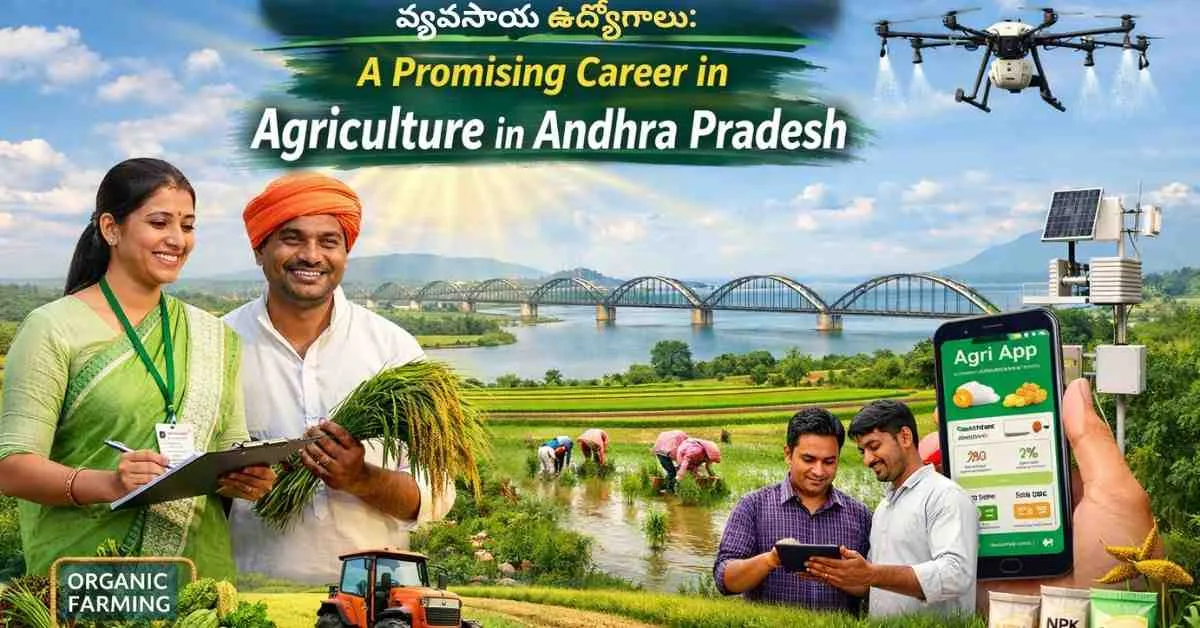
ఆంధ్రప్రదేశ్ లో వ్యవసాయం అంటే కేవలం పొలం దున్నడం కాదు — ఇది రాష్ట్ర ఆర్థిక వ్యవస్థకు వెన్నెముక. దాదాపు 60% ప్రజలు ప్రత్యక్షంగా లేదా పరోక్షంగా agriculture మీద ఆధారపడి జీవిస్తున్నారు. But here’s what most people miss: behind the fields, there’s a growing ecosystem of professional jobs — AEO, ADA, Farm Manager, QC Officer, Lab Technician, Agri Analyst — that offer stable careers with government benefits. If you’ve completed B.Sc Agriculture, Horticulture, or Seed Technology and are looking for a secure, respected career path, AP Agriculture Jobs deserve your full attention.
వ్యవసాయ ఉద్యోగాల తాజా నోటిఫికేషన్స్ మిస్ అవ్వకుండా ఉండాలంటే ఇప్పుడే మా అధికారిక WhatsApp ఛానల్లో జాయిన్ అవ్వండి!
WhatsApp Channel
The Real State of AP Agriculture Jobs
AP లో agriculture sector is transforming. The government is pushing digital services, soil testing labs, drone monitoring, and smart farming programs through Rythu Bharosa Kendrams (RBKs). This modernization is creating entirely new job categories — not just traditional field roles, but tech-enabled positions that combine agricultural knowledge with digital tools. The Department of Agriculture, Horticulture Department, and AP Seed Development Corporation are the primary recruiting bodies.
Also Read
AP Agriculture Exams Preparation: APPSC వ్యవసాయ పరీక్షలకు ఎలా సిద్ధం కావాలి? సిలబస్ & స్టడీ ప్లాన్
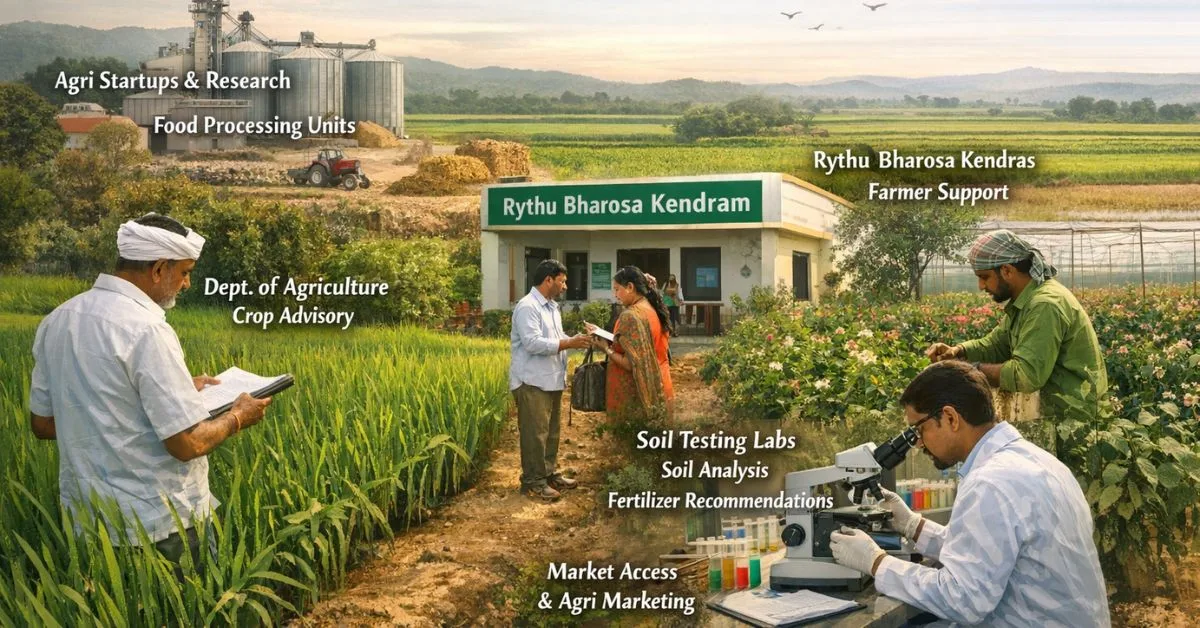
కానీ ఇక్కడ important distinction undi: government jobs offer stability, pension, and social respect. Private sector jobs offer faster growth, modern tech exposure, and performance-based rewards. Both have their place — your choice depends on your priorities. Let me break down both paths.
Top Government Roles (APPSC Recruited)
| ప్రమాణం | అవసరం |
|---|---|
| విద్యార్హత | B.Sc Agriculture / Horticulture / Seed Tech |
| వయస్సు పరిమితి | 18 నుండి 42 సంవత్సరాలు |
| స్థానికత | AP Local Certificate తప్పనిసరి |
| దరఖాస్తు విధానం | APPSC లేదా RBK Network ద్వారా |
Official Website: psc.ap.gov.in
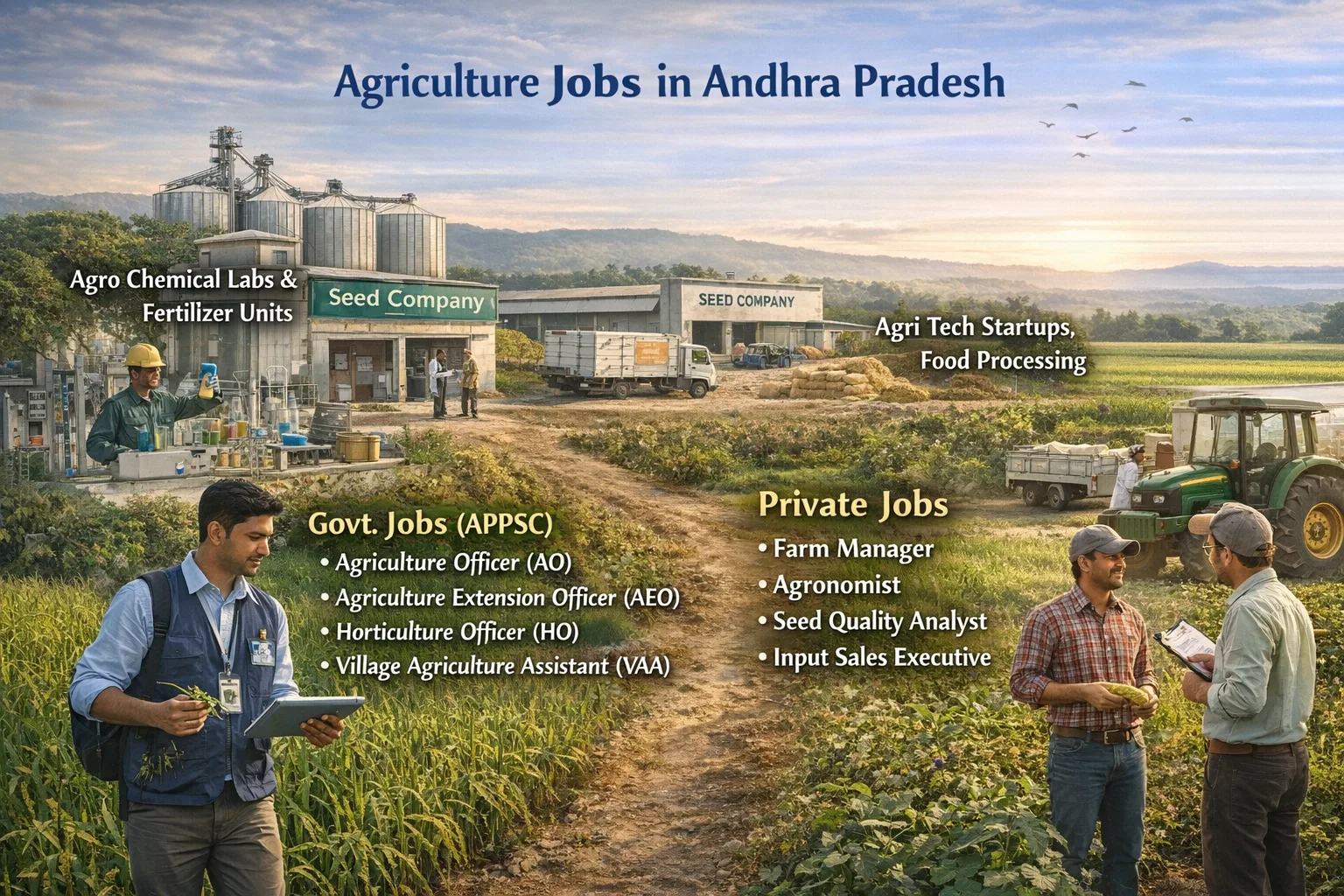
Key Government Posts:
- Agriculture Extension Officer (AEO): The entry-level field role. You’ll work directly with farmers — guiding them on crop selection, pest management, and government schemes. This is where most agriculture graduates start their government career.
- Agriculture Officer (AO): A step above AEO with more supervisory responsibility. You’ll oversee multiple AEOs and handle district-level agricultural planning.
- Assistant Director of Agriculture (ADA): Mid-senior management role. Policy implementation, team leadership, and district-level agricultural strategy fall under this position.
- Horticulture Officer (HO): Specialized in fruit, vegetable, and ornamental crop cultivation. Works through the Horticulture Department with separate recruitment cycles.
- Village Agriculture Assistant (VAA): Grassroots position working at the village level — often recruited through RBK centers.
Also Read

District-Wise Agriculture Jobs Andhra Pradesh – జిల్లా వారీ వ్యవసాయ ఉద్యోగాలు AP పూర్తి మార్గదర్శిని
Top Private Sector Roles
- Farm Manager: Oversee commercial farm operations for agribusiness companies. Requires practical crop management skills and business acumen.
- Agronomist: Scientific crop advisor — optimizing yields through soil science, crop rotation, and precision agriculture techniques.
- Seed Quality Analyst / QC Technician: Work in seed companies and testing labs ensuring seed quality meets standards. Detail-oriented, lab-based roles.
- Agri Data Analyst: The newest category — using data from soil sensors, drones, and weather stations to inform farming decisions. Tech-savvy agriculture graduates thrive here.
- Input Sales Executive: Represent fertilizer, pesticide, and seed companies in the field. Combines agricultural knowledge with sales skills.
Salary Structure: Government vs Private
| కెరీర్ దశ | సుమారు నెల జీతం |
|---|---|
| Entry Level | ₹32,000 – ₹38,000 |
| 5 Years Experience | ₹45,000 – ₹55,000 |
| Senior Level | ₹60,000 – ₹75,000+ |
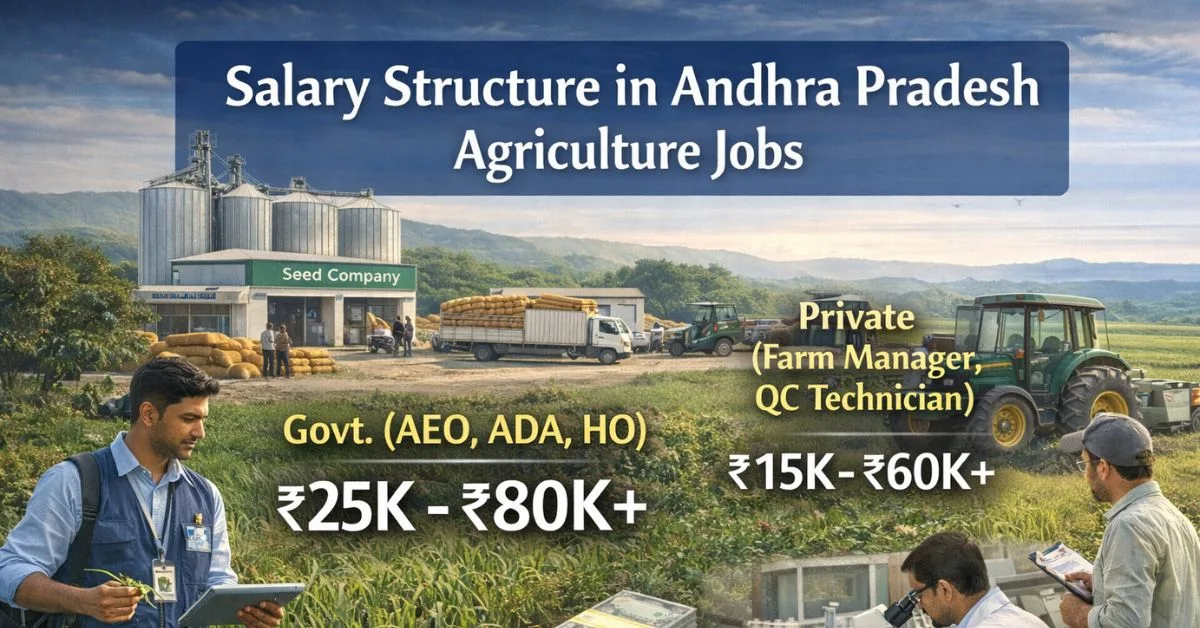
Government AEO starting salary: ₹25,000 – ₹35,000. ADA / Horticulture Officer level: ₹50,000 – ₹80,000. Government employees additionally receive HRA, DA, and other allowances. Private sector: Farm Manager and QC Technician roles start at ₹15,000 – ₹30,000 and can reach ₹60,000+ with experience. Agri-tech companies pay Field Executives ₹25,000 – ₹45,000. Seed companies pay Quality Assistants ₹22,000 – ₹40,000. The total package in government is often more attractive when you factor in benefits, job security, and pension.
Selection Process: How to Get In
APPSC conducts a transparent, merit-based selection. Here’s the process:
- APPSC Online Notification: Released periodically based on vacancy requirements. Monitor psc.ap.gov.in regularly.
- Preliminary & Mains Examination: Written exams testing your agricultural knowledge and general aptitude.
- Interview: Personal interview assessing your communication, practical knowledge, and suitability for field roles.
- Document Verification: Degree certificates, local certificate, caste certificate (if applicable), and other documents.
- Mandal / District Posting: Placement based on merit rank and vacancy distribution.
- Soil & Water Management: Practical, hands-on knowledge — not just textbook theory
- Computer & Data Entry: RBK portals, farmer databases, and reporting systems are now digital
- Pest & Disease Identification: Real field identification skills — farmers will show you affected crops, not textbook pictures
- Farmer Counseling & Communication: The ability to explain technical concepts in simple Telugu to farmers is invaluable
- Report Writing: In both Telugu and English — government documentation is bilingual
- GIS, Drone Monitoring: Emerging technologies that give you a competitive edge
- Soil Testing Certification: Offered by agricultural universities. Practical soil analysis skills are directly tested in interviews.
- GIS and Remote Sensing Basics: Online courses from ISRO or agricultural universities. Drone monitoring and satellite-based crop assessment are the future of AP agriculture.
- Organic Farming Certification: With the government’s push toward natural farming, this certification carries significant weight.
- Computer Proficiency (CCC or equivalent): RBK portals, farmer databases, and digital reporting are now daily job requirements.
- Pest and Disease Management Workshop: Hands-on workshops by agricultural extension centers build practical identification skills.
- Join Telegram/WhatsApp groups: AP agriculture aspirant groups share notification updates, study materials, and motivation. Find groups that are serious and focused — avoid ones filled with spam.
- Connect with current AEOs and AOs: If you know anyone already in service, ask them about their preparation strategy. Their insights about the interview stage and on-job realities are invaluable.
- Follow agriculture department social media: AP Agriculture Department’s official handles post scheme updates, new initiatives, and policy changes — all potential interview questions.
- Attend Krishi Melas and agricultural exhibitions: These events expose you to latest technologies, government programs, and networking opportunities. Plus, demonstrating awareness of current agricultural events impresses interview panels.
- Consider a mentor: A senior aspirant who has already cleared the exam, or a professor from your agriculture college, can provide personalized guidance and accountability.
- RBK (Rythu Bharosa Kendram) Recruitment: These village-level centers recruit year-round for various positions. The selection is less competitive than APPSC and provides valuable field experience while you continue preparing for officer-level exams.
- Contractual Positions: Various agriculture department projects hire on a contractual basis. These temporary roles build your resume and give you practical exposure that helps in APPSC interviews.
- AP Seed Development Corporation: Separate recruitment cycles for seed quality, production, and certification roles. Keep an eye on their official notifications.
- NABARD and Cooperative Banks: Agriculture graduates are eligible for officer positions in rural and cooperative banks. The exam pattern differs but your subject knowledge transfers well.
- Sleep well the night before: At least 7 hours. A tired brain makes silly mistakes. Don’t study new material the night before the exam — light revision only.
- Reach the exam center early: Plan your route the day before. Aim to arrive 45-60 minutes before gate closing. Rushing creates unnecessary anxiety.
- Read instructions carefully: Before diving into questions, spend 2-3 minutes reading the exam instructions completely. Understand mark distribution and negative marking (if any).
- Time allocation strategy: Quickly scan the entire paper. Answer the easy questions first — this builds confidence and secures marks. Come back to difficult questions later.
- Don’t get stuck: If a question takes more than 2 minutes, mark it and move on. You can return if time permits. Getting stuck on one question can cost you 5 easy questions elsewhere.
- Stay hydrated and calm: Carry water. Take deep breaths if you feel anxious. You’ve prepared for months — trust your preparation.
Notification Timeline
| ఉద్యోగం | నోటిఫికేషన్ సమయం | నియామక అధికారి |
|---|---|---|
| AEO | April – June | APPSC |
| AO | August – October | APPSC |
| HO | December | Horticulture Dept. |
| RBK Jobs | Year-round | RBK Centers |
Exam Pattern
Paper 1: General Studies & Mental Ability (150 marks) + Paper 2: Core Agriculture Subjects (300 marks) + Interview (50 marks). Syllabus includes agronomy, soil science, seed technology, pest and disease management, and agricultural economics. Practice previous papers, study 6 hours daily, and take mock tests every 2 weeks for optimal results.
Essential Skills Beyond Your Degree
Degree alone won’t guarantee success in AP Agriculture Jobs. Field skills, communication, and technology awareness are equally critical:
During your B.Sc Agriculture or Diploma, participate in practical activities: crop observation, soil testing, seed quality checking, pest and disease management fieldwork. This hands-on experience builds the foundation for roles like AEO, ADA, and Farm Manager.
Career Growth and Promotion Ladder
| స్థాయి | పదవి | సగటు సంవత్సరాలు |
|---|---|---|
| Level 1 | AEO / VAA | 0–3 years |
| Level 2 | Agriculture Officer (AO) | 4–6 years |
| Level 3 | Deputy Director / ADA | 8–10 years |
| Level 4 | Joint Director / DAO | 12+ years |
Agriculture is now merging with technology — smart irrigation, drone spraying, soil testing through RBKs, GIS mapping, and online farmer advisory platforms are creating new technical roles. Private sector seed companies, agri-tech startups, and R&D labs are increasing investments. GIS mapping and drone survey skills position you at the cutting edge of this transformation.
Comparison: Government vs Private
| అంశం | ప్రభుత్వం | ప్రైవేట్ |
|---|---|---|
| స్థిరత్వం | అధికం | మధ్యస్థం |
| వేతన వృద్ధి | Slow, steady | Fast, performance-based |
| పని స్థలం | Villages, mandals | Cities, corporate offices |
| ఒత్తిడి | Moderate | High |
| Benefits | Pension, HRA, DA, security | Variable, company-dependent |
FAQ
Q1: AP Agriculture Jobs ki eligibility enti?
A1: B.Sc Agriculture, Horticulture, or Seed Technology degree from a recognized university. AP local certificate is mandatory. Age limit: 18 to 42 years (with relaxations for reserved categories as per government norms). Application is through APPSC or RBK network.
Q2: Starting salary entha expect cheyochu?
A2: Entry-level government roles (AEO) start at ₹25,000 – ₹35,000 per month. With experience (5 years), this reaches ₹45,000 – ₹55,000. Senior positions (ADA, HO) command ₹60,000 – ₹80,000+. HRA, DA, and other allowances add significantly to total compensation. Private sector starting salaries range ₹15,000 – ₹30,000, rising to ₹60,000+ with experience.
Q3: APPSC agriculture notification eppudu release avutundi?
A3: AEO notifications typically release between April and June. AO notifications between August and October. Horticulture Officer notifications around December. RBK center jobs are recruited year-round. Monitor psc.ap.gov.in regularly — notifications can change based on vacancy situations.
Q4: Selection process ela untundi?
A4: Preliminary exam → Mains exam → Interview → Document verification → Posting. Paper 1 (General Studies & Mental Ability, 150 marks) + Paper 2 (Core Agriculture Subjects, 300 marks) + Interview (50 marks). The process is transparent, merit-based, and conducted by APPSC.
Q5: Degree unte chala? Extra skills avasarama?
A5: Degree is the entry ticket — but not enough for success. Practical field skills (soil testing, pest identification, crop management), computer proficiency (RBK portals, data entry), communication skills (farmer counseling), report writing (Telugu & English), and emerging tech awareness (GIS, drone monitoring) significantly improve your selection chances and on-job performance. Built during your degree through practical fieldwork, not just classroom study.
Building Your Competitive Edge: Certifications and Skill-Building
While a B.Sc Agriculture degree is your entry ticket, additional certifications can dramatically improve your selection chances and career growth. Consider these high-impact add-ons during or after your degree:
These certifications appear on your resume and become conversation points during the interview. They signal to the selection panel that you’re proactive and genuinely invested in agriculture beyond just securing a job.
Networking and Mentorship: The Hidden Advantage
Your preparation is largely solo work — but that doesn’t mean you should go it alone. Smart networking can provide advantages that textbooks cannot:
Alternate Entry Points into AP Agriculture Jobs
The APPSC route is the most common path, but it’s not the only one. Consider these alternatives — especially as backup options while you prepare:
How to Handle Exam Day Stress
Preparation is 80% of success — but the remaining 20% is how you perform on exam day. Here’s how to ensure all your hard work translates into results:
Final Advice
AP Agriculture Jobs offer more than employment — they offer the opportunity to transform farmers’ lives and strengthen rural economies. The path requires dedicated preparation: know the syllabus thoroughly, practice previous papers, build practical field skills during your degree, stay updated on APPSC notifications, and approach the process with patience and discipline. Agriculture isn’t just a career choice — it’s a way to serve while building a stable, respected professional life. Start your preparation today. 🚜
Explore more agriculture career guides and job updates at GardenHacks — your trusted source for AP agriculture opportunities.
మూలాలు
- APPSC అధికారిక వెబ్సైట్ – ఆంధ్రప్రదేశ్ పబ్లిక్ సర్వీస్ కమిషన్
- ఆంధ్రప్రదేశ్ ప్రభుత్వం అధికారిక వెబ్సైట్
- ఆంధ్రప్రదేశ్ వ్యవసాయ శాఖ అధికారిక పోర్టల్
సంబంధిత కథనాలు
- Agriculture Officer (AO) జీతం ఎంత? ప్రమోషన్ అవకాశాలు & భవిష్యత్ గ్రోత్
- AO AEO Study Plan – 30 రోజుల్లో ఎక్కువ మార్కులు సాధించే పూర్తి గైడ్
- Agriculture Entrepreneurship & Consultancy Careers (Advanced) – వ్యవసాయ వ్యాపారం & కన్సల్టెన్సీ కెరీర్ గైడ్ (Andhra Pradesh)
వ్యవసాయ ఉద్యోగాల తాజా నోటిఫికేషన్స్ మిస్ అవ్వకుండా ఉండాలంటే ఇప్పుడే మా అధికారిక WhatsApp & Telegram ఛానళ్లలో జాయిన్ అవ్వండి!
 WhatsApp Channel
 Telegram Channel

నేను A. Ushasree. gardenhacks.in లో వ్యవసాయ ఉద్యోగాలు, రైతు పథకాలు, హోమ్ గార్డెనింగ్ వంటి విభాగాలపై సరళమైన తెలుగులో ఉపయోగకరమైన సమాచారాన్ని పంచుకుంటాను. రైతులు మరియు సాధారణ కుటుంబాలకు ఉపయోగపడే సమాచారం అందించడం నా లక్ష్యం.