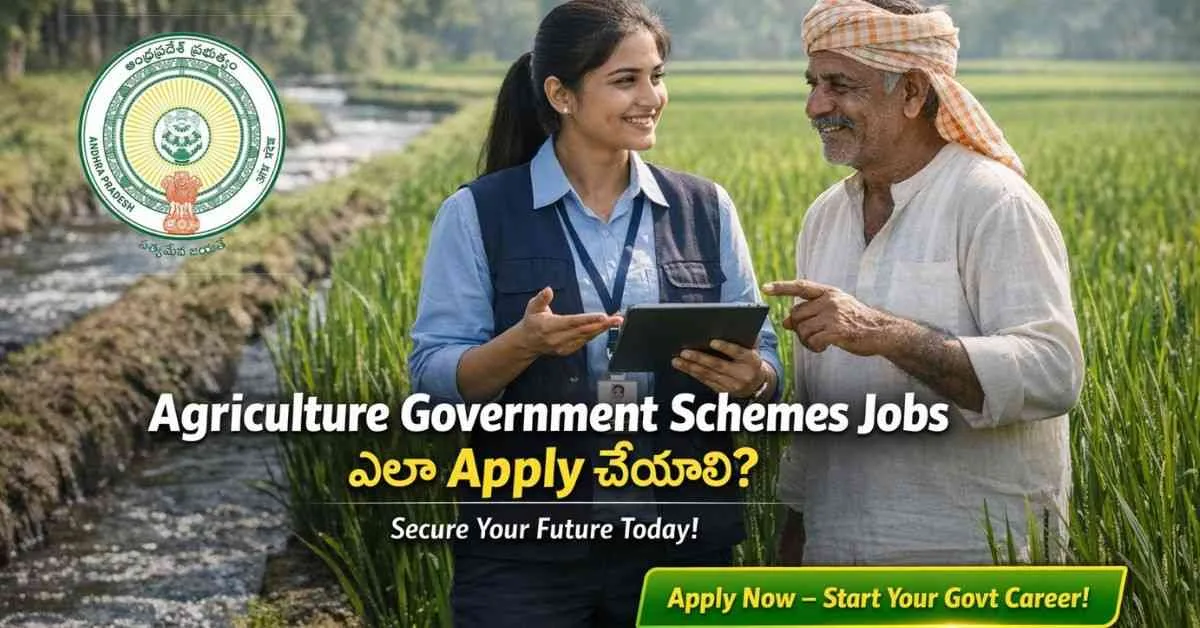
Agriculture Government Schemes Jobs — ee term vinte chala mandi BSc Agriculture students ki first thought em vastundi ante “mari government job eh na, inkem special ga undi?” But nijam cheppalante, these are among the most stable, respected, and socially impactful government jobs available in Andhra Pradesh today. They are not just regular desk jobs — these are field-oriented positions where you directly work with farmers and implement multi-crore government welfare schemes on the ground.
Andhra Pradesh lo agriculture is the backbone of the rural economy. Over 60% of the population depends on farming directly or indirectly. To support this massive sector, the government runs dozens of schemes — Annadatha Sukhibhava, crop insurance, seed subsidies, fertilizer distribution, Rythu Bharosa, free borewell schemes, micro-irrigation subsidies, and many more. Ee schemes anni plan cheyadaniki, implement cheyadaniki, monitor cheyadaniki specific government posts untaayi. Aa posts ni collective ga Agriculture Government Schemes Jobs antaru.
వ్యవసాయ ఉద్యోగాల తాజా నోటిఫికేషన్స్ మిస్ అవ్వకుండా ఉండాలంటే ఇప్పుడే మా అధికారిక WhatsApp ఛానల్లో జాయిన్ అవ్వండి!
WhatsApp Channel
Also Read
GIS Analyst Agriculture – స్మార్ట్ ఫార్మింగ్ లో GIS కెరీర్, సాలరీ, కోర్సులు
Ee article lo, asalu ee jobs enti, ela apply cheyali, em posts untaayi, salary entha, career growth ela untadi, and district-wise real work environment gurinchi complete ga explain chesthanu. BSc Agriculture or Horticulture complete chesina prati student ki ee information clear ga theliyali — because these jobs are not just another career option, these are among the best government sector opportunities that directly use your degree.
Ippativaraku chala mandi students ki ee jobs gurinchi proper info ledu. APPSC notifications vachina kuda confusion lo miss avtharu. Syllabus edo vague ga telustundi, but actual job responsibilities, field conditions, promotion ladder — ivi clear ga teliyavu. Ee article chadivesaka, you will know exactly what to prepare for, how to apply, and what your career will look like if you get selected.
What Are Agriculture Government Schemes Jobs Exactly?
Let me define this clearly. Agriculture Government Schemes Jobs are government posts specifically created to plan, implement, monitor, and report on various agricultural welfare and development schemes run by the state and central governments. These jobs exist at multiple levels — state, district, mandal, and even village — with each level having specific responsibilities.
Examples of the schemes these officers handle include the Annadatha Sukhibhava income support scheme where farmers receive direct financial assistance, crop insurance enrollment and claim processing, seed and fertilizer subsidy distribution, soil health card generation and distribution, micro-irrigation subsidy verification, and organic farming promotion programs. Each scheme requires boots on the ground — officers who visit farms, verify claims, collect data, and ensure benefits reach the right farmers.
The distinction between these scheme-linked jobs and general agriculture department jobs is important. While an Agriculture Officer or AEO handles overall extension work, scheme-linked roles specifically focus on making sure government programs reach the intended beneficiaries. This requires a mix of technical knowledge, administrative ability, and strong field presence.

In Andhra Pradesh, these posts are mainly under the Department of Agriculture and the Department of Horticulture. Recruitment is primarily through APPSC for gazetted posts, while some village-level and contract positions may be recruited through district selection committees or RBK networks.
Why Are These Jobs So Important in Andhra Pradesh?
Andhra Pradesh has one of the most diverse agricultural landscapes in India. From the lush paddy fields of the Godavari delta to the drought-prone groundnut farms of Anantapur, every district has unique challenges. Government schemes cannot be “one size fits all” — they need local adaptation and careful implementation. That is exactly why scheme-linked officers are crucial.
In coastal districts like East Godavari, West Godavari, and Krishna, where canal irrigation is abundant, schemes focus on high-yield paddy production, mechanization, and preventing over-use of water and chemicals. In Rayalaseema districts like Kurnool, Anantapur, and Chittoor, where rainfall is scarce, the focus shifts to drought-resistant crops, water conservation subsidies, and crop insurance. Without officers who understand these local conditions, even the best-designed scheme fails at the implementation level.
Additionally, the government’s push for digital agriculture — e-crop booking, online subsidy applications, direct benefit transfers — means officers now need both agricultural knowledge and digital literacy. This has created a new generation of Agriculture Government Schemes Jobs that are more dynamic and impactful than ever before.
Farmers often don’t know what schemes are available to them. They don’t know how to apply, what documents are needed, or what the deadlines are. Scheme officers bridge this gap. They conduct village meetings, explain benefits in simple Telugu, help with paperwork, and follow up until the benefit reaches the farmer. This is hands-on public service at its best.
Key Posts Under Agriculture Government Schemes Jobs
There are several posts at different levels of hierarchy. Let me break them down by level and responsibility so you understand where you fit based on your qualifications and experience.
District-Level Posts
Agriculture Officer (AO): This is the most well-known post. An AO oversees all scheme implementation in a cluster of mandals within a district. They supervise AEOs, coordinate with district administration, approve subsidy claims, and report progress to the Joint Director. APPSC conducts recruitment through a competitive exam. The salary starts around Rs 45,000 to Rs 55,000 and grows with increments and promotions.
Horticulture Officer (HO): Similar to AO but focused on fruit crops, vegetables, plantation crops, and floriculture. In districts like Chittoor (mango), Anantapur (sweet lime), and parts of Godavari (coconut, banana), Horticulture Officers are in high demand. Recruitment is also through APPSC, sometimes through the Horticulture Department directly.
Assistant Director of Agriculture (ADA): This is a senior post overseeing an entire division within a district. ADAs are usually promoted from the AO cadre after 8 to 10 years of service, but direct recruitment sometimes happens for specialized roles. They handle budgeting, audit, and high-level scheme planning.
Mandal-Level Posts
Agriculture Extension Officer (AEO): The AEO is the backbone of scheme implementation at the mandal level. If you clear the APPSC AEO exam, this is likely your starting role. You will be responsible for 20 to 30 villages, visiting fields regularly, conducting farmer meetings, collecting crop data, verifying subsidy claims, and ensuring scheme awareness. AEOs work closely with RBK staff and are the primary point of contact for farmers in their mandal.
Village Agriculture Assistant (VAA): This is the grassroots-level post. VAAs live in or near their assigned villages and work directly with farmers on a daily basis. They help with crop booking, soil sampling, input distribution, and scheme enrollment. While the salary is lower than AEO or AO, the work is highly respected and offers a direct path to promotion.
Eligibility and Qualifications
To apply for Agriculture Government Schemes Jobs in Andhra Pradesh, you need to meet specific eligibility criteria. First, the educational qualification: a BSc in Agriculture or BSc in Horticulture from a recognized university is the baseline for AO, AEO, and HO posts. For VAA positions, in some cases, a Diploma in Agriculture or even intermediate with agriculture background may be accepted, but degree holders are preferred.
Age limits follow standard APPSC norms — generally 18 to 42 years, with relaxation for SC, ST, BC, and other reserved categories as per government rules. Local candidate status is mandatory. You must have an Andhra Pradesh residence or nativity certificate. This is strictly verified during document verification.
Beyond formal qualifications, certain skills significantly improve your chances of selection and success in the job. You need strong Telugu communication skills because most farmers you interact with are comfortable only in Telugu. You need basic English for report writing and official correspondence. You need computer literacy for data entry on government portals, crop booking systems, and subsidy tracking. And most importantly, you need a genuine willingness to work in rural areas, travel extensively, and engage directly with the farming community.
Salary Structure and Benefits
One of the biggest attractions of Agriculture Government Schemes Jobs is the stable and transparent salary structure with regular increments. Starting salaries for AEO posts are typically in the Rs 35,000 to Rs 45,000 range per month. After 5 years of service, with regular increments, this climbs to Rs 50,000 to Rs 65,000. Senior-level officers like ADA or Joint Director can earn Rs 70,000 to Rs 90,000 plus.
These are base figures. On top of the basic pay, government employees receive Dearness Allowance (DA), which is revised twice a year to adjust for inflation. House Rent Allowance (HRA) is provided if government quarters are not available. Travel Allowance (TA) covers field visit expenses. Medical reimbursement, pension under the new contributory system, and other benefits add significant value. The total effective compensation is considerably higher than just the take-home salary.
Additionally, these jobs come with non-monetary benefits that are hard to quantify. Job security is virtually absolute — government jobs in India are among the most secure employment available. There is social respect in rural areas, where government officers are treated with genuine regard. There is work-life balance, with defined working hours and government holidays. And there is the satisfaction of public service — helping farmers access benefits that improve their livelihoods.
Selection Process and Exam Pattern
APPSC conducts recruitment for most agriculture department posts. The process is transparent and merit-based. It typically includes a preliminary screening test, a mains written examination, and an interview or document verification as the final stage. Some posts may have only a written exam followed by merit-based selection without an interview.
The written exam syllabus covers core agricultural subjects — agronomy, soil science, entomology, plant pathology, horticulture, agricultural economics, and extension education. Additionally, there is a General Studies and Mental Ability paper covering current affairs, AP state knowledge, reasoning, and quantitative aptitude. The exam is conducted in both Telugu and English, so language is not a barrier for Telugu-medium students.
Key preparation tips: study previous years’ question papers thoroughly to understand the pattern. Master the core agricultural subjects — they carry the most weight. Stay updated on Andhra Pradesh government schemes and agricultural programs. Practice mock tests with time limits. And don’t neglect the General Studies paper — many candidates lose marks here while focusing only on agriculture subjects.
Government vs Private Sector in Agriculture
If you’re choosing between Agriculture Government Schemes Jobs and private sector roles, here is an honest comparison. Government jobs offer unmatched stability, fixed working hours, pension benefits, and social respect. Private sector jobs — in agri-input companies, food processing, agri-tech startups, or banks — offer faster salary growth, corporate exposure, and sometimes more exciting work with modern technology.
In government service, your posting is typically in rural or semi-urban areas — mandal headquarters or district towns. In private sector, you may be posted in cities or urban centers. Government work pressure is moderate and seasonal, peaking during sowing and harvest seasons. Private sector has consistent year-round targets and deadlines. Government promotions are time-bound and seniority-based. Private sector promotions are performance-based and can be faster.
There’s no right or wrong choice — it depends on your personality and priorities. If stability, public service, and work-life balance matter most, government schemes jobs are perfect. If rapid career growth, higher earning potential, and corporate experience attract you, private sector may suit better. Many graduates take government jobs first, build experience, and then explore entrepreneurship or private sector later. The career is long, and you can always pivot.
District-Wise Work Environment and Realities
Your work experience in Agriculture Government Schemes Jobs will vary significantly depending on which district you’re posted in. Let me give you a realistic picture of each region.
In coastal districts like East Godavari, West Godavari, Krishna, and Guntur, agriculture is intensive and irrigated. Paddy, sugarcane, chilli, and aquaculture dominate. As a scheme officer here, you’ll deal with input subsidy verification, crop insurance for high-value crops, and canal water management coordination. The volume of work is high because the cropping intensity is high — multiple seasons, multiple crops.
In Rayalaseema districts — Kurnool, Anantapur, Chittoor, Kadapa — farming is largely rain-fed with periodic drought stress. Your work will focus more on drought relief schemes, crop loss assessment, insurance claims processing, and promoting water-saving technologies. The work has periods of intense activity during monsoon failure, when farmer distress is high and government intervention is critical.
In tribal and agency areas of Visakhapatnam, Vizianagaram, and Srikakulam, the challenges are different — shifting cultivation, low productivity, lack of market access, and special tribal welfare schemes that need dedicated officers. Postings here are sometimes remote but offer unique experiences and faster promotions due to the hardship factor.
Career Growth and Promotion Path
One of the strong points of Agriculture Government Schemes Jobs is the well-defined promotion ladder. You typically start as an AEO or equivalent entry-level officer. After 4 to 6 years of satisfactory service, you become eligible for promotion to Agriculture Officer (AO). After 8 to 10 more years, you can move to Assistant Director (ADA) level. Senior positions like Deputy Director, Joint Director, and Director of Agriculture are achievable over a full career span of 25 to 30 years.
Promotions are based on a combination of seniority, performance reports, and departmental exams. There are also opportunities for deputation to other departments, project positions in externally funded programs, and training assignments at agricultural universities. The career offers variety — you can move between field postings, administrative roles, and policy positions over the years.
Daily Work Life – What to Expect
What does a typical day look like for someone in Agriculture Government Schemes Jobs? Most days start at the mandal agriculture office around 9 or 10 AM. You check files, review pending applications, and plan field visits. By late morning, you’re in a village, visiting farms, talking to farmers, inspecting crops, or verifying scheme benefits. Afternoon might involve returning to the office to write reports, update digital records, or attend coordination meetings with other departments.
During peak seasons — sowing time, harvest time, or when a natural calamity occurs — field work intensifies. You might be out from morning till evening, covering multiple villages. The work is physically demanding but deeply satisfying because you see the direct impact of your efforts. When a farmer receives their insurance claim on time because you helped process it, or when a subsidy reaches a small farmer who desperately needed it, the sense of purpose is strong.
Paperwork and reporting are significant parts of the job too. Every scheme has reporting requirements. You need to maintain records, upload data to portals, and prepare monthly progress reports for higher authorities. Accuracy and timeliness in documentation are essential because audits happen regularly and public money is involved.
Challenges and How to Handle Them
No job is perfect, and Agriculture Government Schemes Jobs have their challenges. The first is managing farmer expectations. Farmers often expect immediate solutions and quick disbursal of benefits. When processes take time, they may become frustrated and direct that frustration at you. Patience, clear communication, and genuine empathy go a long way in handling these situations.
The second challenge is bureaucratic processes. Government systems have defined procedures, multiple approvals, and documentation requirements. This can be slow and frustrating. Understanding the system, building good relationships with colleagues in other departments, and being proactive with paperwork helps you navigate this smoothly.
The third challenge is field work during extreme weather. Visiting farms in peak summer heat or during heavy rains is part of the job. Physical fitness and practical preparation — proper clothing, water, vehicle maintenance — are important. The fourth challenge is political pressure sometimes. As a government officer, you may face requests to bend rules. Maintaining integrity while being polite but firm is an essential skill you develop over time.
Frequently Asked Questions (FAQ)
1. What is the minimum qualification for Agriculture Government Schemes Jobs?
BSc Agriculture or BSc Horticulture from a recognized university is required for AO, AEO, and HO posts. VAA positions may accept Diploma holders in some cases. APPSC notifications specify exact educational requirements for each post.
2. How often do APPSC notifications come for agriculture posts?
Major notifications are typically released once every 1 to 2 years, usually for AEO and AO posts. Keep checking the APPSC website (psc.ap.gov.in) and employment news regularly. Sometimes, notifications for specific scheme-linked posts come through district-level recruitment as well.
3. Is Telugu compulsory for these jobs?
Telugu is not always formally tested, but it is practically essential. All farmer interactions are in Telugu. Reports may be written in English or Telugu. Being fluent in both languages is a major advantage.
4. Can I choose my posting district?
Usually, postings are based on vacancies and roster rules. However, local candidate status and certain preferences may be considered. Once you join, transfers can be requested after serving a minimum period, subject to departmental rules.
5. Is there age relaxation for reserved categories?
Yes, standard APPSC age relaxation rules apply. SC/ST candidates typically get 5 years relaxation, BC candidates get 3 years, and physically handicapped candidates get 10 years, subject to prevailing rules at the time of notification.
Ultimately, a career in Agriculture Government Schemes Jobs is about more than salary and stability — it’s about being part of the system that supports lakhs of farmers across Andhra Pradesh. If you’re a BSc Agriculture graduate looking for a meaningful, secure, and respected government career, these posts deserve your serious attention.
మూలాలు
- APPSC అధికారిక వెబ్సైట్ – ఆంధ్రప్రదేశ్ పబ్లిక్ సర్వీస్ కమిషన్
- ఆంధ్రప్రదేశ్ ప్రభుత్వం అధికారిక వెబ్సైట్
- ఆంధ్రప్రదేశ్ వ్యవసాయ శాఖ అధికారిక పోర్టల్
సంబంధిత కథనాలు
- Agriculture Entrance Exams – Andhra Pradesh వ్యవసాయ విద్యార్థుల పూర్తి మార్గదర్శిని
- APPSC AEO Previous Papers, Cutoff & Preparation Strategy – పూర్తి గైడ్
- APPSC Agriculture Jobs in Andhra Pradesh – జీతం, అర్హతలు & వ్యవసాయ ప్రభుత్వ ఉద్యోగాల పూర్తి గైడ్
వ్యవసాయ ఉద్యోగాల తాజా నోటిఫికేషన్స్ మిస్ అవ్వకుండా ఉండాలంటే ఇప్పుడే మా అధికారిక WhatsApp & Telegram ఛానళ్లలో జాయిన్ అవ్వండి!
 WhatsApp Channel
 Telegram Channel

నేను A. Ushasree. gardenhacks.in లో వ్యవసాయ ఉద్యోగాలు, రైతు పథకాలు, హోమ్ గార్డెనింగ్ వంటి విభాగాలపై సరళమైన తెలుగులో ఉపయోగకరమైన సమాచారాన్ని పంచుకుంటాను. రైతులు మరియు సాధారణ కుటుంబాలకు ఉపయోగపడే సమాచారం అందించడం నా లక్ష్యం.